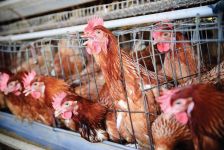
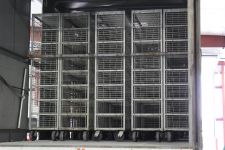


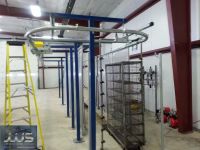


Take a minute to watch the cage cleaning in action with the video on this page.
SEQUENCE OF OPERATION for Automatic Poultry Cage Wash
Overview
The cage wash is an automatic conveyorized medium-pressure wash system designed to wash the specific cages as specified by the Owner.
The wash control panel contains the controls for the timer mechanisms, Solenoid valves, fill and float switches, cage position sensors and motor starter. There is also an Off/Auto/Emergency Stop Switch for Automatic operation control.
The conveyor is designed to maintain a consistent speed from start to finish. The low speed is 30 feet per minute and the high speed is 60 feet per minute, the conveyor speed is infinitely adjustable between the low and high speeds. The initial travel speed is set to 30 FPS with expectations that after several days of washing, higher speeds can be attained while achieving the cleaning results desired. Conveyor control and speed is independent from wash spray control allowing speed adjustments without interfering with wash control and process.
Soap application is controlled by a sensing device which detects when the cage arrives and departs the soap station automatically turning on and off the chemical pump and soap sprays.
Pressure sprays are directed laterally across the cage surface from right to left as the cage passes by. This is automatically controlled by sensors to detect the position of the cage in relation to the spray bars. Once the cage has cleared the right side spray bar, a 3-way valve directs the sprays to the left side spray bar which sweeps the cage with medium pressure water from left to right. This is powered by a 15HP 60 GPM pump which turns on and off automatically while the cage travels through.
The equipment for the wash lane includes 2 Stainless Steel 2” pipes, located in specific positions in the wash bay. These pipes contains 10 Stainless Steel nozzle tips spaced evenly over a 78” span directed at a 5 degree angle. The nozzles spray 6 GPM each which provides a solid wall of water from the ground up to completely clean the cages from both sides. The chemical applications consist of corrosion proof PVC spray bars designed specifically for the owners cages.
Disinfection sprays are activated the same way the soap sprays are, using sensors to detect the cage position and turning on and off the sprays automatically.
The equipment room consists of a 15HP fresh water pump, a 250 gallon water holding tank, automatic controls and valves to refill the holding tank, the control panel, chemical pumps, a 3 way valve and an air compressor.
The default programming is set to stop any device from running after 60 seconds, for safety reasons, in case a cage were to get stuck in the wash area.
Whenever a fault occurs in the system, the wash system will shut down all motors and valves that are associated to that alarm to protect from any damage to the equipment. All faults must be acknowledged, corrected and reset using the E-Stop button.
Download this information as a PDF
For more information, this PDF is a study conducted by J. K. Northcutt and M. E. Berrang to determine the effectiveness of an automated commercial washing system (https://academic.oup.com/japr/article/15/3/457/725225?searchresult=1).